Currently Empty: ₹0.00


Uncategorized
DevOps Roadmap for Freshers in 2026: A Step-by-Step Guide
By Annwen Technology · DevOps, Cloud, AIOps & MLOps training in Tamil Nadu · About a 10-minute read
Want to become a DevOps engineer but don’t know where to start? You are not alone. Most freshers try to learn Docker, Kubernetes and AWS all at once from random videos, get confused, and give up. The secret is order: each DevOps tool builds on the one before it.
In this guide we share the exact 5-month, step-by-step DevOps roadmap we follow at Annwen Technology to take freshers, students, non-IT learners and professionals returning after a career gap from zero to job-ready. You can follow it on your own, or learn it with us.
The 5-month DevOps roadmap at a glance
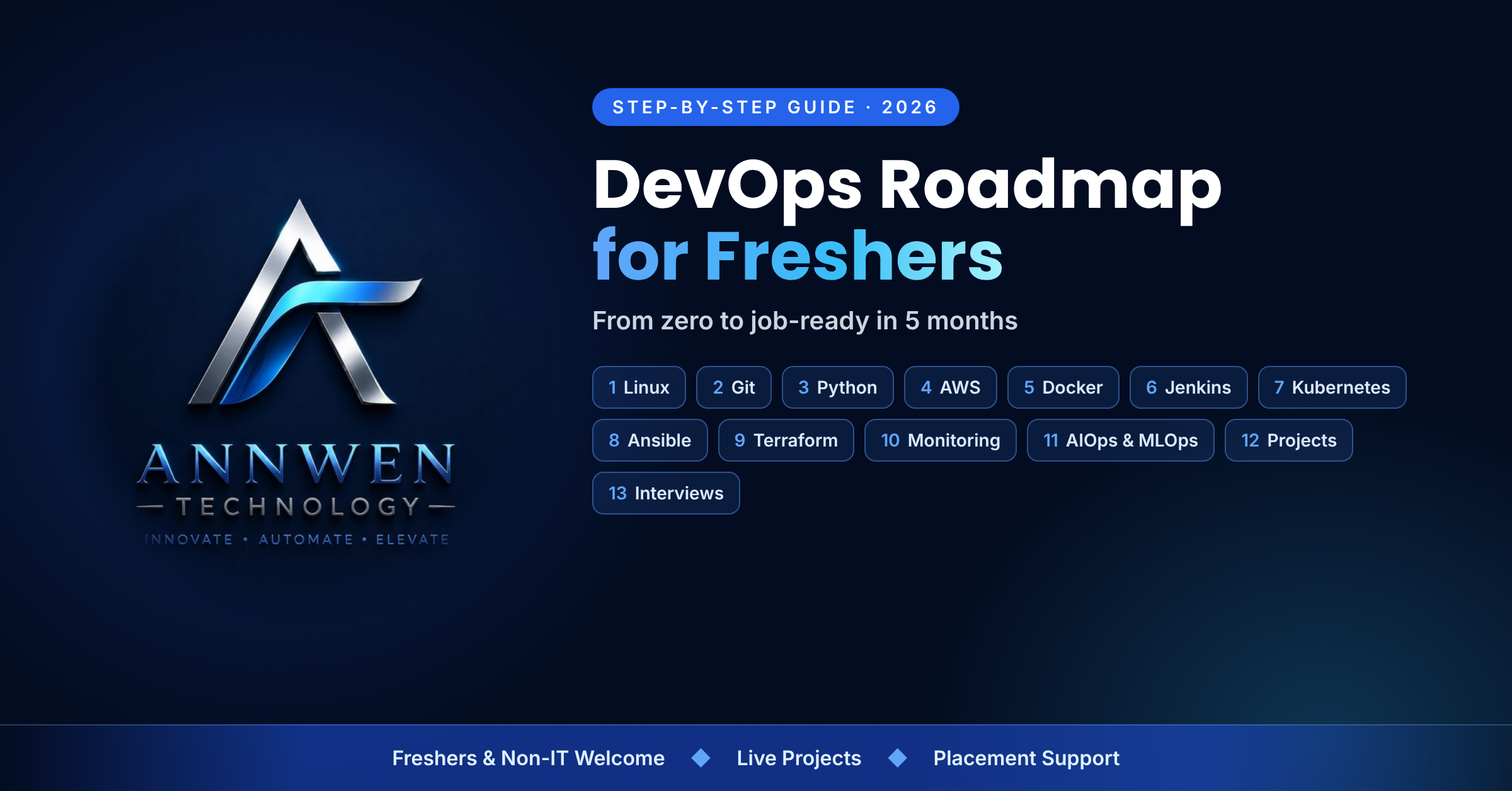
- Weeks 1–4: Linux, Git & Python
- Weeks 5–8: AWS Cloud
- Weeks 9–13: Docker, Jenkins, Kubernetes, Ansible
- Weeks 14–17: Terraform, Monitoring, AIOps & MLOps
- Week 18: 2 live end-to-end projects
- Weeks 18–22: Interview prep, resume, LinkedIn, Naukri & mock interviews
Who is this roadmap for?
- Final-year students and freshers looking for their first IT job
- Non-IT graduates who want to move into IT
- IT professionals in support, testing or development who want to move into DevOps or cloud
- Professionals and homemakers restarting their career after a break
You don’t need prior DevOps knowledge. Basic computer skills and about 2 hours of practice a day are enough to follow this plan.
PHASE 1
Foundations (Weeks 1–4)
WEEKS 1–2
Step 1: Linux Basics
Almost every server in the cloud runs Linux, so this is where every DevOps journey starts.
- Linux commands, files and directories, permissions and users
- Processes, services, package management and logs
- Networking basics: IP, ports, DNS, SSH
- Shell scripting to automate everyday tasks
✅ Outcome: you can log in to a server and manage it confidently from the command line.
WEEK 3
Step 2: Git & GitHub
Every DevOps pipeline starts with code in a Git repository.
- Commits, branches, merges and resolving conflicts
- GitHub repositories, pull requests and team workflows
✅ Outcome: you can manage code like a real development team.
WEEK 4
Step 3: Python Basics for Automation
DevOps engineers write small scripts to automate repetitive work. Python is the easiest language to start with.
- Variables, loops, functions, files and error handling
- Working with APIs and JSON
- Simple automation scripts for servers and the cloud
✅ Outcome: you can automate tasks instead of doing them by hand.
PHASE 2
Cloud (Weeks 5–8)
WEEKS 5–8
Step 4: AWS Cloud
Most companies run their applications in the cloud. We learn AWS early so that every tool after this is practised on real cloud servers.
- EC2 (servers), S3 (storage), IAM (users and security)
- VPC, subnets, security groups and load balancers
- Auto Scaling, RDS and CloudWatch
- Deploying a real application on AWS
✅ Outcome: you can build and secure a working cloud setup on AWS.
PHASE 3
Core DevOps Tools (Weeks 9–13)
WEEK 9
Step 5: Docker
Docker packages an application with everything it needs, so it runs the same way everywhere.
- Images, containers, Dockerfiles, volumes and networks
- Docker Compose for multi-container apps
✅ Outcome: you can containerise any application.
WEEK 10
Step 6: Jenkins – CI/CD
Now that you know Git, Docker and AWS, Jenkins ties them together into an automatic pipeline.
- Jobs, pipelines and Jenkinsfiles
- Automatic build, test and Docker image creation on every code change
- Deploying automatically to AWS
✅ Outcome: you can build a complete CI/CD pipeline.
WEEKS 11–12
Step 7: Kubernetes
Kubernetes runs and manages containers at scale. It is one of the most asked-about skills in DevOps interviews.
- Pods, Deployments, Services, ConfigMaps and Secrets
- Scaling, rolling updates and troubleshooting
- Running Kubernetes on AWS (EKS)
✅ Outcome: you can deploy and manage containerised apps in production.
WEEK 13
Step 8: Ansible
Ansible configures many servers at once with simple, readable files.
- Inventory, playbooks, roles and variables
- Installing and configuring software across multiple servers
✅ Outcome: you can set up 1 server or 100 servers the same way, automatically.
PHASE 4
Automation, Monitoring & AI (Weeks 14–17)
WEEKS 14–15
Step 9: Terraform (Infrastructure as Code)
Instead of clicking around the AWS console, you describe your whole infrastructure in code.
- Providers, resources, variables, outputs and state
- Modules and building a full AWS environment with code
✅ Outcome: you can create and rebuild cloud infrastructure in minutes.
WEEK 16
Step 10: Prometheus & Grafana
Once an application is live, you need to know if it is healthy. This step takes 3–4 days.
- Collecting metrics with Prometheus
- Building dashboards in Grafana and setting up alerts
✅ Outcome: you can monitor applications and catch problems early.
WEEKS 16–17
Step 11: AIOps & MLOps Basics
AI is changing how IT operations work. We cover the fundamentals so you stay ahead.
- AIOps: using AI to detect issues, reduce alert noise and automate operations
- MLOps: how machine-learning models are built, deployed and monitored with DevOps practices
✅ Outcome: you understand where DevOps is heading and can talk about it in interviews.
PHASE 5
Projects & Placement Preparation (Weeks 18–22)
WEEK 18 · 2–3 DAYS
Step 12: Two Live End-to-End Projects
You bring everything together: code in GitHub, a Jenkins pipeline, Docker images, Kubernetes on AWS, infrastructure with Terraform, and monitoring with Prometheus and Grafana.
✅ Outcome: two real projects to show on your resume and explain in interviews.
WEEKS 18–20
Step 13: Interview Preparation
We go through the real questions asked in DevOps interviews, topic by topic, until every concept is clear.
- Technical questions on every tool in this roadmap
- Scenario and troubleshooting questions
- How to explain your projects with confidence
WEEK 21
Step 14: Resume, LinkedIn & Naukri Optimisation
Recruiters search for specific keywords. We make sure your profiles show up and stand out.
- A DevOps-focused resume that highlights your projects
- LinkedIn profile and Naukri profile optimisation
WEEKS 21–22
Step 15: Mock Interviews
Practise technical and HR rounds in a real interview setting, with feedback after each one. At Annwen Technology, mock interviews are unlimited.
✅ Outcome: you walk into real interviews prepared and confident.
After week 22: at Annwen Technology the learning doesn’t stop at the course. We continue to support you with job applications and interview preparation until you are placed.
The full 5-month plan in one table
| Weeks | Topic | Duration |
|---|---|---|
| 1–2 | Linux Basics | 2 weeks |
| 3 | Git & GitHub | 1 week |
| 4 | Python Basics | 1 week |
| 5–8 | AWS Cloud | 4 weeks |
| 9 | Docker | 1 week |
| 10 | Jenkins – CI/CD | 1 week |
| 11–12 | Kubernetes | 2 weeks |
| 13 | Ansible | 1 week |
| 14–15 | Terraform | 2 weeks |
| 16 | Prometheus & Grafana | 3–4 days |
| 16–17 | AIOps & MLOps Basics | 1–1.5 weeks |
| 18 | 2 Live Projects | 2–3 days |
| 18–20 | Interview Preparation | 3 weeks |
| 21 | Resume, LinkedIn & Naukri | 1 week |
| 21–22 | Mock Interviews | 2 weeks |
5 tips to finish this roadmap successfully
- Practise every day. 2 hours of hands-on practice beats 6 hours of only watching videos.
- Follow the order. Skipping Linux or AWS makes Kubernetes and Terraform much harder later.
- Push everything to GitHub. Your GitHub profile becomes your portfolio.
- Explain what you learn. If you can teach a topic to a friend, you can answer it in an interview.
- Don’t wait to feel “ready”. Start mock interviews on schedule; confidence comes from practice.
Frequently asked questions
Can a fresher learn DevOps in 5 months?
Yes. With daily practice and the right order of topics, 5 months is enough to learn the core tools, build projects and prepare for interviews.
Can non-IT graduates learn DevOps?
Yes. The roadmap starts from Linux basics and builds step by step, so no prior IT or DevOps knowledge is needed.
Do I need to know coding to learn DevOps?
Only basic scripting. We teach the Python and shell scripting you need for automation in weeks 1–4.
Can I restart my IT career after a career gap with DevOps?
Yes. Many learners return to work through DevOps. A structured plan, two live projects and strong interview preparation help you explain your gap with confidence.
Is this course available online?
Yes. Annwen Technology offers classroom training in Manalikarai & Kumarapuram (Kanyakumari district) and live online batches for students anywhere in Tamil Nadu.
🚀 FREE LIVE WEBINAR
AI-Powered DevOps Career Masterclass
Saturday, November 21, 2026 · 6:00 PM – 8:00 PM IST · Google Meet
Discover the technologies, practical skills and interview strategies you need to start a DevOps career. Freshers and non-IT learners welcome.
Want to follow this roadmap with expert guidance?
Join Annwen Technology’s 5-month DevOps course: classroom in Manalikarai & Kumarapuram or live online, with real-time projects, unlimited mock interviews and placement support.
Annwen Technology is an IT training institute in Tamil Nadu offering job-oriented DevOps, AWS Cloud, Kubernetes, AIOps and MLOps training. Learn Today. Build Tomorrow. · +91 90256 14123